Mon–Fri 7:30–5 · Sat 8–12New patients seen within the week · (713) 555-0168
Hip pain
Treatments
Hip Health Library Saturday Hip Pain Clinic About Dr. Stride Location & hours Request an appointment
Hip pain guide

Why Does the Hip Feel So Stiff?

What causes a stiff hip?

A stiff hip is most often caused by hip osteoarthritis, which reduces rotation and makes socks, shoes and getting out of a car harder. In younger adults, femoroacetabular impingement can limit motion. Inflammatory arthritis such as rheumatoid arthritis or ankylosing spondylitis causes long morning stiffness. Tight muscles and recovery from injury or surgery are other common causes.

Hip stiffness often creeps up so slowly that people adjust without noticing. They sit on the edge of the bed to put on socks, ask a spouse to tie a shoe or give up the low sports car. Stiffness is often the earliest sign of a hip problem, well before pain becomes severe. Finding the cause early gives you more options to keep the hip moving.

Grandfather kneeling on the floor to build blocks with his grandson

Where it is usually felt

Get this checked →(713) 555-0168

How patients describe it

Putting on socks and tying shoes on that side takes real effortThe first steps out of bed in the morning are stiff and slowGetting in and out of the car means lifting the leg with both handsCutting toenails on that foot is nearly impossible nowThe hip loosens up after walking for a while, then aches again laterCrossing that leg over the other knee is no longer possible

The most common causes

Hip osteoarthritis

Adults over 50 and younger adults with past hip injury, FAI or dysplasia

As the cartilage wears, the joint capsule thickens and bone spurs form around the ball and socket. Rotation, especially turning the leg inward, is usually the first motion lost. Stiffness is typically worst in the morning and after sitting, and loosens within about 30 minutes of moving.

The clue: Gradual difficulty with socks, shoes and toenails, with stiffness after sitting, is the classic pattern.

Femoroacetabular impingement (FAI)

Active adults roughly 18 to 50

Extra bone on the ball or the socket rim blocks full motion, especially bending and turning the leg inward. The hip feels tight rather than painful at first. Over time the limited motion can lead to labral tears and cartilage damage.

The clue: A hard stop with a pinch when bending the hip past 90 degrees, in a younger adult, suggests impingement.

Inflammatory arthritis

Adults of any age, including younger people with ankylosing spondylitis or rheumatoid arthritis

Conditions such as rheumatoid arthritis, psoriatic arthritis and ankylosing spondylitis inflame the joint lining. They often affect more than one joint and may involve the lower back. Early diagnosis and treatment with a rheumatologist protect the joint.

The clue: Morning stiffness lasting more than an hour that improves with exercise suggests inflammation rather than wear.

Tight hip flexors and muscles

Desk workers, cyclists, drivers with long commutes and people recovering from back pain

Long hours of sitting shorten the hip flexors and stiffen the muscles around the hip. The joint itself is healthy. This type of stiffness improves fairly quickly with stretching and activity.

The clue: Tightness at the front of the hip when standing up straight after long sitting, with full rotation on exam, points to the muscles.

Osteonecrosis (avascular necrosis)

Adults 30 to 60 with long-term steroid use, heavy alcohol use, sickle cell disease or a past hip injury

Reduced blood flow causes part of the ball of the hip to weaken and, in later stages, collapse. It may start with groin pain and progress to stiffness. Early stages may only be visible on MRI.

The clue: New groin pain and stiffness in someone with steroid or heavy alcohol use calls for an MRI.


Get seen right away if

  • A stiff, hot, swollen hip with fever, which may be infection
  • Sudden loss of motion with severe pain after a fall
  • Stiffness in several joints with swelling and fatigue
  • Night pain with stiffness and unexplained weight loss

What to expect at your first visit

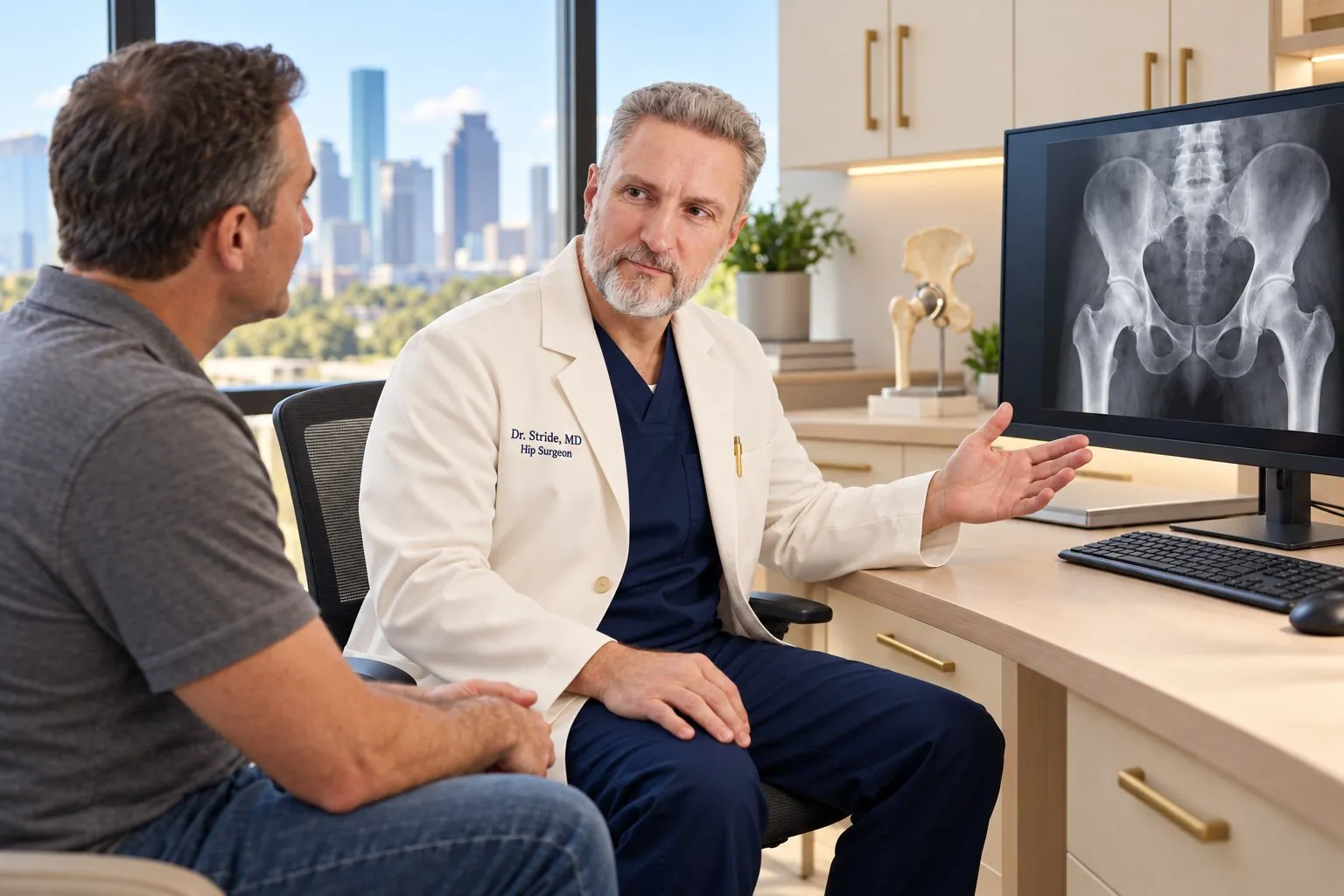
Dr. Stride measures hip motion in every direction and compares it to the other side, with special attention to internal rotation, which is usually lost first in arthritis. He notes whether motion stops with a hard bony block, which suggests impingement or spurs, or a softer muscular end. He watches you walk, stand from a chair and step up, and checks the lower back and knee because both affect how the hip moves. He also asks how long morning stiffness lasts and whether other joints are involved, to screen for inflammatory arthritis. Standing X-rays show joint space, bone spurs and the shape of the ball and socket. Blood tests or an MRI are added when inflammation or osteonecrosis is a concern.

“Bring your outside X-rays and MRI. I’ll go through them with you, but how your hip moves on the exam table tells me just as much as the pictures.”

Dr. Stride, MD

Treatment options, from simplest to most involved

  1. Step 1

    Daily motion and strength work

    A structured program of hip range-of-motion exercises and strengthening, often over 6 to 12 weeks, restores some lost motion and makes daily tasks easier.

    Hip Physical Therapy →
  2. Step 2

    Activity and weight plan

    Low-impact exercise like cycling, swimming and walking keeps the joint moving. Losing even a modest amount of weight reduces the load on an arthritic hip.

    Hip Activity & Weight Plan →
  3. Step 3

    Medication

    Anti-inflammatory medicine before activity can ease stiffness enough to exercise, when your health allows. Inflammatory arthritis is managed together with a rheumatologist.

    Hip Pain Medication →
  4. Step 4

    Cortisone injection

    An image-guided cortisone injection into the joint can calm an arthritis flare for weeks to months and make therapy more productive.

    Cortisone Hip Injection →
  5. Step 5

    FAI surgery for younger hips

    In younger adults with impingement and healthy cartilage, reshaping the bone arthroscopically can restore motion and protect the joint.

    FAI Surgery →
  6. Step 6

    Hip replacement

    When arthritis has worn the joint and stiffness and pain limit daily life, a hip replacement restores motion in most patients.

    Total Hip Replacement →

What you can do at home now

  • Take a warm shower or use a heating pad for 15 minutes before stretching in the morning
  • Ride a stationary bike for 10 to 15 minutes with the seat set high
  • Use a sock aid and a long-handled shoehorn during stiff stretches
  • Get up and move every 30 to 45 minutes when sitting
  • Try gentle hip circles and knee-to-chest stretches without forcing into pain

Frequently asked questions

Why is the hip stiff in the morning?

Morning hip stiffness that eases within about 30 minutes is typical of osteoarthritis. Stiffness that lasts more than an hour and improves with exercise suggests inflammatory arthritis. Both deserve an exam and X-rays.

Can a stiff hip be loosened with stretching?

Stretching helps when tight muscles are the cause and can improve comfort in arthritis. When bone spurs or impingement physically block motion, stretching has limits. An exam shows whether the stop is muscle or bone.

Is hip stiffness a sign of needing a hip replacement?

Not necessarily. Many people with stiff, arthritic hips do well for years with exercise, weight control and occasional injections. A replacement is considered when pain and stiffness limit daily life despite those measures.

Why is it hard to put on socks with hip arthritis?

Putting on socks requires bending and rotating the hip at the same time, which are the first motions lost in arthritis. That is why many patients notice sock and shoe trouble before significant pain.

Treatments for stiff hip

Other types of hip pain

SourcesReferences used for this page3

Medically reviewed by Dr. Stride, MD against current guidance from these sources. Last reviewed October 2026. How we write and review content

  1. Hip Osteoarthritis (opens in a new tab) AAOS OrthoInfo
  2. Hip Arthritis: Causes, Symptoms & Treatment Options (opens in a new tab) Cleveland Clinic
  3. Femoroacetabular Impingement (opens in a new tab) AAOS OrthoInfo
CallBook a visit