

01
Front of hip
“A deep ache in the groin after sitting through a long meeting”
Usually caused by
- Femoroacetabular impingement (FAI)
- Hip labral tear
- Hip osteoarthritis

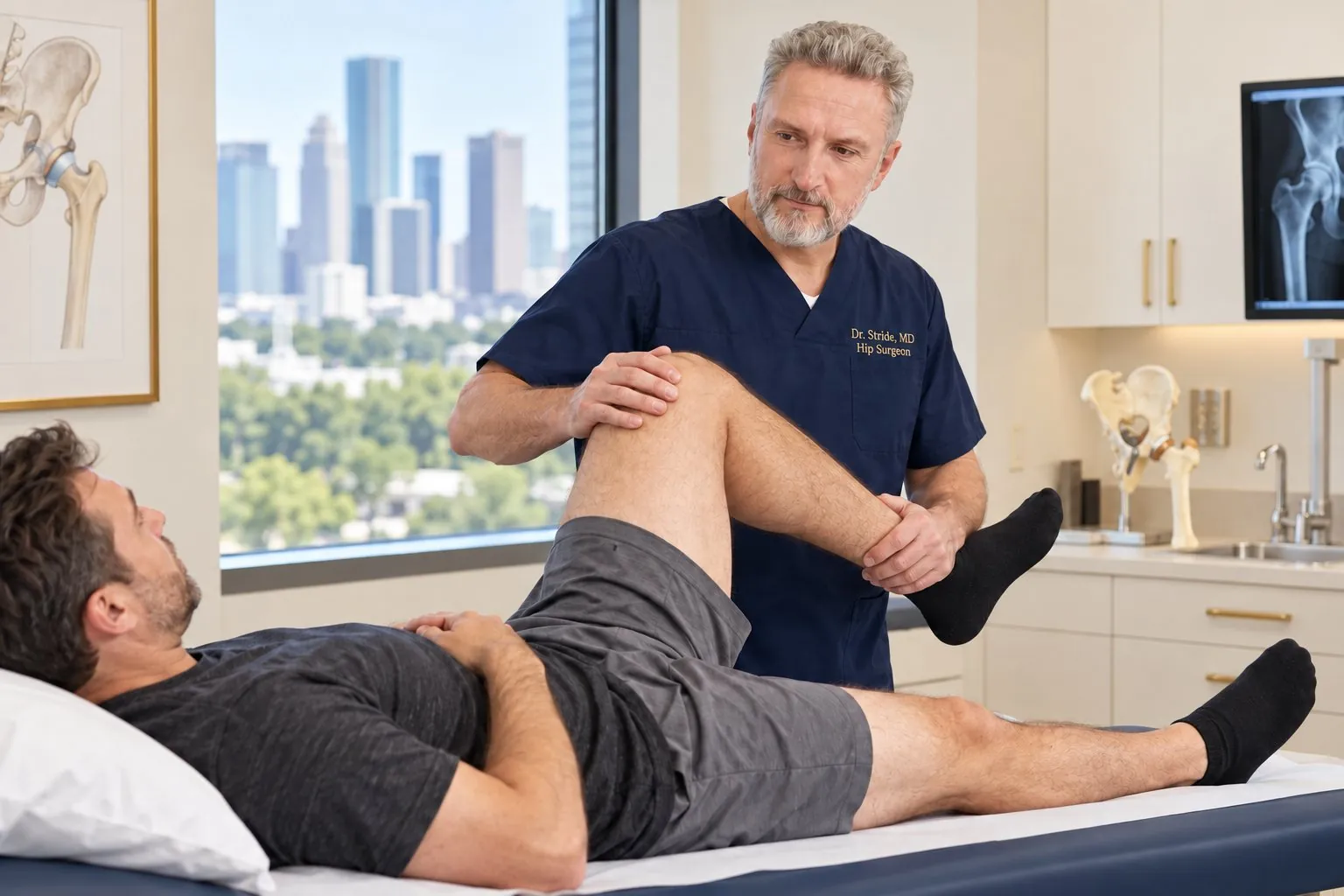

Dr. Stride is a board-certified, fellowship-trained hip surgeon. He sees every patient himself, from the first exam to the last follow-up.
“You should leave your first visit knowing exactly what is going on with your hip, and what we are going to do about it.”
Trail walks with patients, free hip screenings at health fairs and plain answers at the front desk. Dr. Stride wants you moving, and he shows up to help.

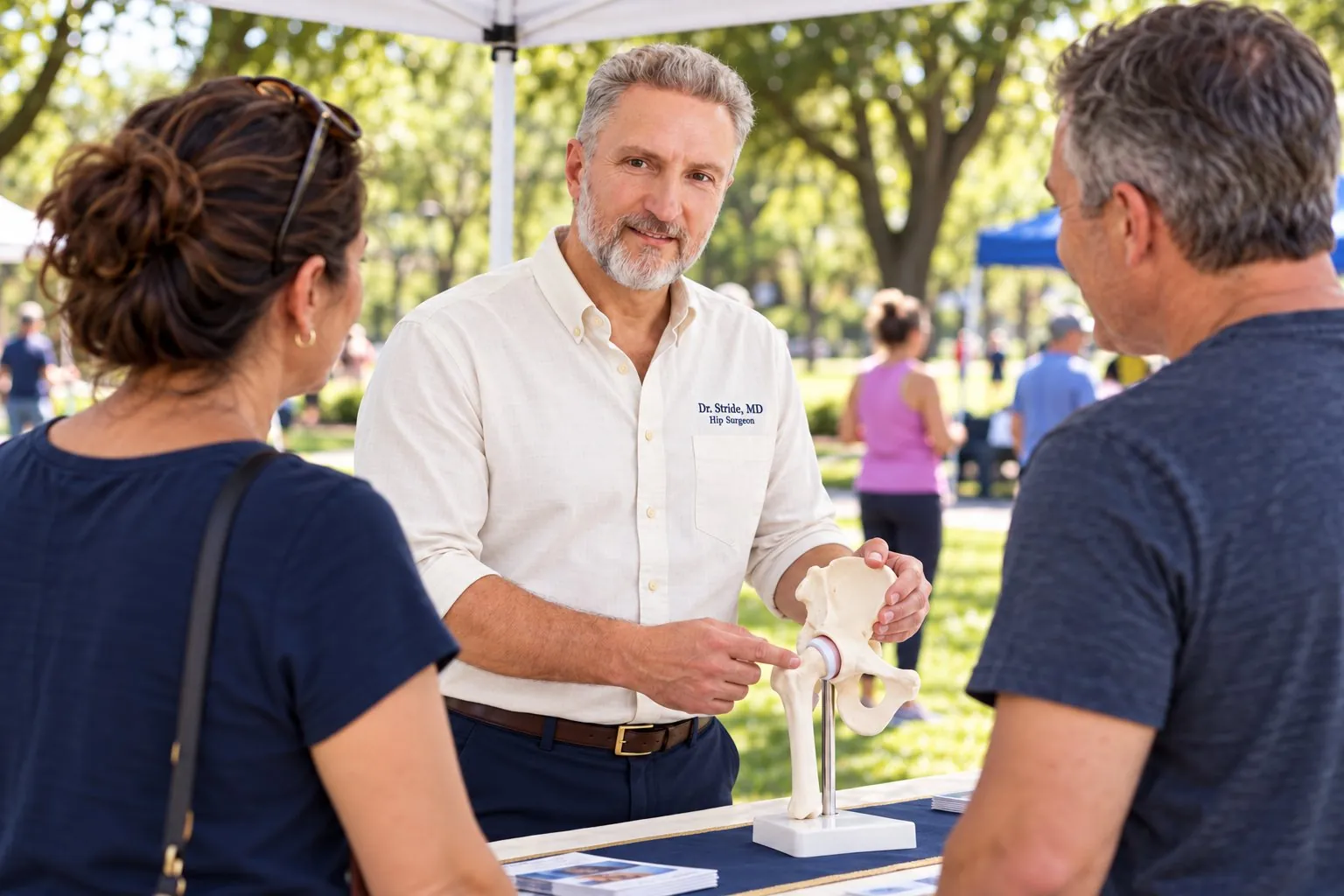

 In the community
Hip Surgeon · Houston
Dr. Stride is a board-certified, fellowship-trained orthopedic surgeon whose practice is dedicated entirely to the hip. Young athletes with labral tears, golfers with stiff hips and adults weighing a hip replacement see him personally, from the first exam to the last follow-up.
“Seeing hips all day means I can tell you which ones need a new joint and which ones need a good plan and some patience. Saving the hip you have is always the first question.”
Patients rarely arrive with a diagnosis. They arrive with a feeling. Pick the one that sounds like yours to see what usually causes it.
“A deep ache in the groin after sitting through a long meeting”

“It hurts to lie on that side at night”

“Sitting on a hard chair hurts right on the sit bone”

“Rolling onto that side at night wakes the hip right up”

“Putting on socks and tying shoes on that side takes real effort”

“There's a clunk at the front of the hip when lowering the leg from a sit-up”
Not on the list? See every hip pain guide or call (713) 555-0168.
From the first exam to the last follow-up, your care stays with one fellowship-trained hip surgeon. Choose a category to see what it includes.

A hip specialist diagnoses hip pain with a hands-on exam that includes gait analysis, range of motion and tests such as FADIR and FABER, plus standing pelvis X-rays. An MRI or MR arthrogram shows labral tears and tendon problems, and an image-guided numbing injection confirms whether pain comes from the hip joint or elsewhere.
Explore diagnosis →
Yes, most hip pain can be treated without surgery. Physical therapy that strengthens the glutes and core, short courses of anti-inflammatory medicine, activity changes and weight management help most patients with tendinopathy, labral tears and early arthritis.
Explore non-surgical →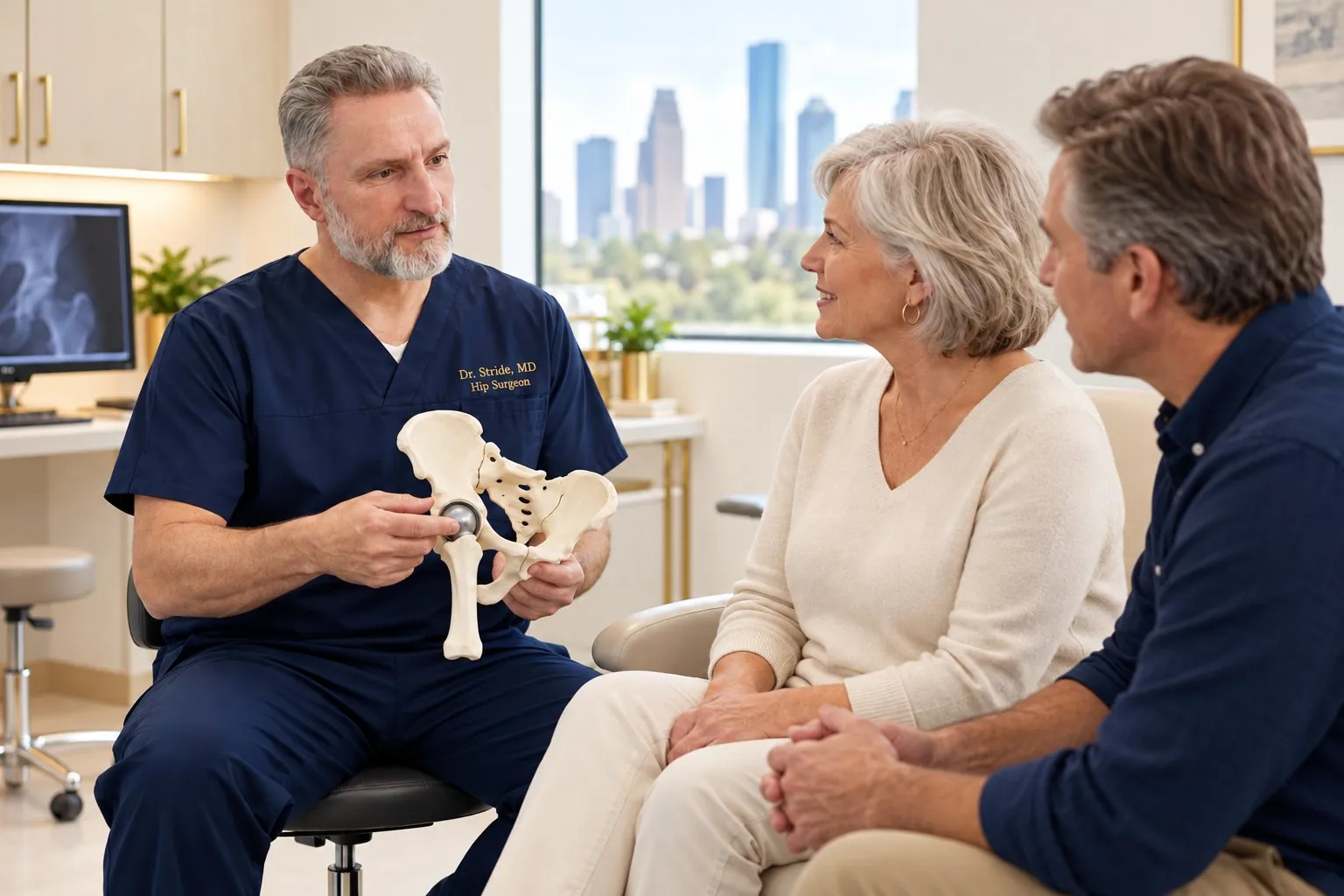
Hip pain injections include cortisone into the joint for arthritis flares, cortisone near the trochanteric bursa for outer hip pain, platelet-rich plasma (PRP) for stubborn tendon problems and some early arthritis, and diagnostic numbing injections to confirm the pain source. Radiofrequency nerve ablation can ease arthritis pain in patients who are not ready for surgery.
Explore injections →Hip preservation surgery treats the structural causes of hip pain in younger, active adults before arthritis develops. It includes hip arthroscopy to repair labral tears and reshape bone in femoroacetabular impingement, endoscopic gluteal tendon repair, and periacetabular osteotomy to correct hip dysplasia.

Hip replacement is usually considered when arthritis or osteonecrosis causes pain that limits walking, sleep and daily activities despite several months of therapy, medication and injections, and X-rays confirm significant joint damage. Age alone does not decide it.
A broken hip almost always needs surgery, usually within 24 to 48 hours, to fix the bone with screws, a rod or a plate, or to replace the ball. Early surgery allows walking within a day or two, which lowers the risk of blood clots, pneumonia and loss of independence.
Explore fracture →
Pain from the lower back often shows up in the buttock, the groin or down the thigh, right where hip pain lives. Dr. Stride examines the spine at every visit, so you are treated for the problem you actually have.
Every plan starts with the least invasive treatment that can work and moves forward only when your hip needs it.
Hip motion tests, gait analysis, standing X-rays and a review of any MRI. You leave knowing what is wrong.
Physical therapy, activity changes, medication or a guided injection. Many patients never need more.
Hip arthroscopy, tendon repair or osteotomy to protect the joint you have.
Total hip replacement, often outpatient and home the same day.
Golf, running, pickleball and yoga each load the hip differently. Choose yours to see the problems Dr. Stride treats most often and how he gets people back to them.
Common hip problems
A swing-aware plan that protects the hip and the lower back
Book a hip evaluation →Common hip problems
Graded return-to-run plans built around your race calendar
Book a hip evaluation →
Common hip problems
Non-surgical options first, so you stay on the court
Book a hip evaluation →Common hip problems
Range-of-motion goals set around your practice
Book a hip evaluation →Common hip problems
Strength work and position advice to keep you riding
Book a hip evaluation →Common hip problems
A plan aimed at the things you want to get back to
Book a hip evaluation →Saturday Hip Pain ClinicEvery Saturday morning, Dr. Stride sees new hip pain and second opinions. Bring your X-rays and MRI. You get a hands-on exam, X-rays on site when needed and a clear plan before you leave.
| Typical urgent care | Saturday Hip Pain Clinic | |
|---|---|---|
| Who you see | General provider | Hip surgeon |
| Hip exam | Brief | Motion, impingement and strength tests |
| Imaging | X-ray | X-ray on site, MRI reviewed or ordered |
| Second opinion | Not offered | Bring your images and the recommendation you were given |
| Follow-up | “See an orthopedist” | You already did |
After a fall, if you cannot put weight on the leg, the leg looks shorter or turned out, or you have hip pain with a fever, go to the nearest emergency room.
From the first tee to the floor with the grandkids, these are the comebacks the practice is built for.
Sample testimonials for this website concept · replace with verified patient reviews before launch“Two years of groin pain and three opinions. Dr. Stride found the labral tear at the first visit and I was back on the trail by spring.”
“I came in sure I needed a new hip. Therapy and one injection later, I am playing nine holes again and the surgery talk can wait.”
“Home the same day after my hip replacement and walking the block with a cane by the end of the week.”
“The outside of my hip hurt every night. A clear diagnosis and the right exercises fixed the sleep problem first.”
“I walked in on a Saturday with my MRI on a disc and left with a plan before lunch.”
“My dysplasia was found at 24. The PAO was a big surgery, and the rehab plan made every month feel like progress.”
Side-by-side guides to the four hip decisions patients ask about most, with recovery and trade-offs laid out plainly.
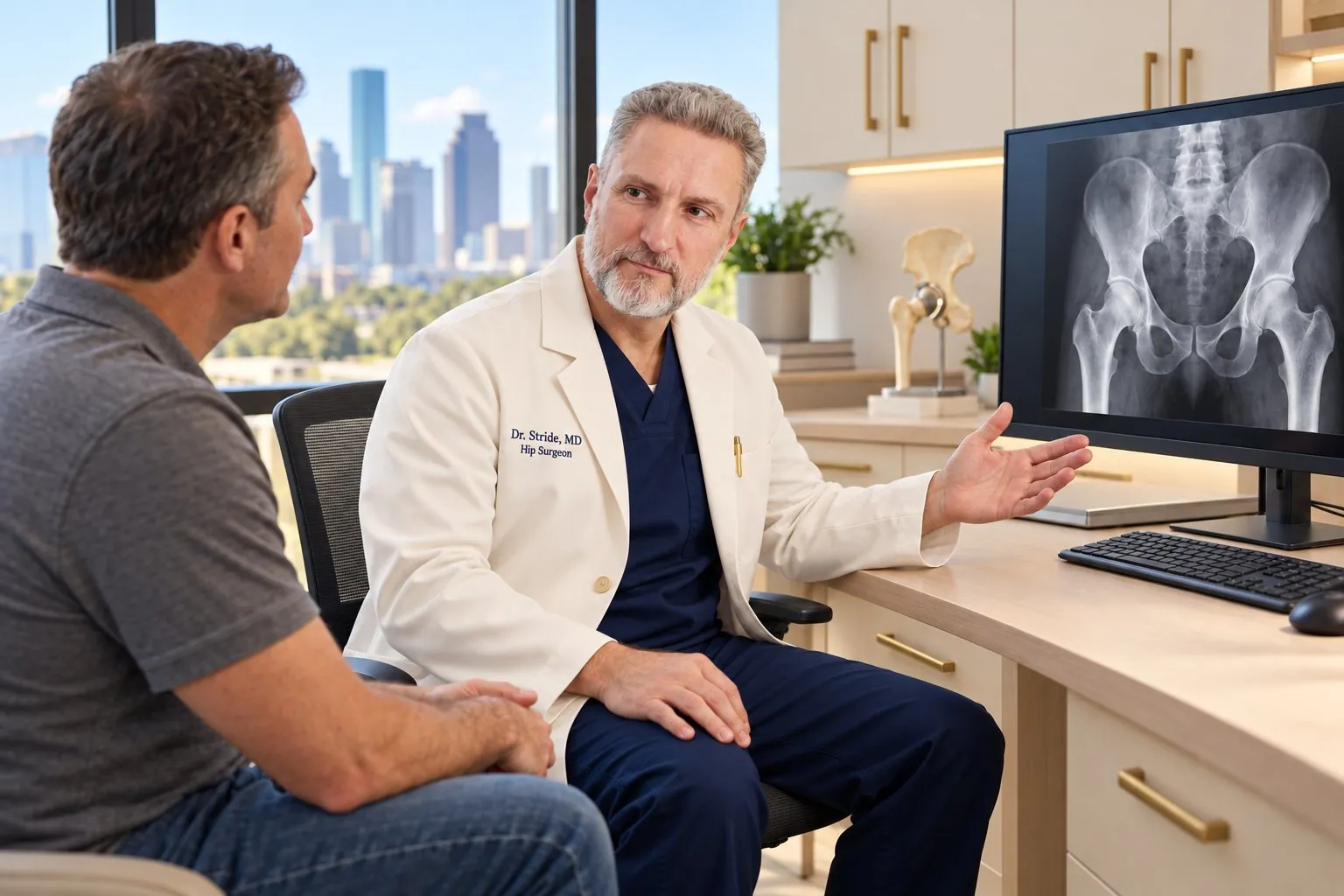
Go to the ER for hip pain after a fall if you cannot stand or the leg looks shortened or turned out, if a replaced hip suddenly pops out, if a hot swollen hip comes with fever, or if back pain comes with groin numbness or bladder changes.
Hip pain is serious if you cannot put weight on the leg, the leg looks shortened or turned out after a fall, the joint is hot and swollen with fever, or the pain is sudden and severe.
Yes, a hip can be broken even without a bruise.
A torn hip labrum usually causes deep groin or front-of-hip pain that worsens with sitting, pivoting and deep bending, often with clicking, catching or locking.
At Gessner and the Katy Freeway, a short drive from Memorial, Spring Branch, Katy and The Heights.
Typical drive time
Most PPO plans and Medicare do not require a referral to see Dr. Stride. HMO plans usually do, and our team checks your coverage when you book and tells you if a referral is needed.
New patients are usually seen within the week. The Saturday Hip Pain Clinic, from 8 AM to noon, is set aside for new hip pain and second opinions, so you do not have to miss work. Call (713) 555-0168 to book.
The practice works with most major insurance plans, including Medicare. Our team verifies your benefits before the visit and explains any expected costs, including for treatments such as PRP that insurance usually does not cover.
Bring your photo ID, insurance card, a list of medications and any hip or spine X-rays, MRI images and reports you already have. If you have had hip surgery before, the operative report helps. Wear shorts or loose pants so the hip is easy to examine.
Most patients do not need surgery. Dr. Stride starts with non-surgical care such as physical therapy, activity changes, medication and injections whenever it can help. Surgery is recommended when those steps have not worked or when the problem, like a hip fracture or advanced arthritis, clearly calls for it.
Yes, second opinions are a core part of the practice. Dr. Stride reviews your X-rays and MRI, examines both the hip and the lower back and explains whether a replacement, a joint-preserving option or more non-surgical care makes the most sense.