
Periacetabular Osteotomy (PAO) to Correct a Shallow Hip Socket
What is a periacetabular osteotomy (PAO) for hip dysplasia?
A periacetabular osteotomy (PAO) is an open surgery that cuts the bone around a shallow hip socket and rotates it into a better position over the ball, then holds it with screws while it heals. It is used for symptomatic hip dysplasia in teens and young adults whose cartilage is still healthy, to relieve pain and delay arthritis.
Hip dysplasia means the socket is too shallow to fully cover the ball of the hip. The load gets concentrated on a small rim of cartilage, which can lead to groin pain, a tired achy hip and early arthritis, often in women in their teens, 20s and 30s. A PAO repositions the socket so the joint shares the load the way it was meant to.
 Written and medically reviewed by Dr. Stride, MD, board-certified orthopedic surgeon
Last reviewed October 2026
At a glance
- Also called
- PAO surgery, Ganz osteotomy, hip dysplasia surgery, pelvic osteotomy
- Typical recovery
- Months 6 to 12
- Category
- Hip Arthroscopy & Preservation
Is Periacetabular Osteotomy (PAO) right for you?
Usually a good fit if
- Hip dysplasia confirmed on X-ray, with a low lateral center-edge angle
- Groin or side-of-hip pain and fatigue that limits work, exercise or sport
- Teens past skeletal maturity and adults usually under about 40 to 45
- Little or no arthritis and a hip that still moves well
- A labral tear caused by dysplasia, which may be treated alongside the PAO
Another option may be better if
- Hips with established arthritis, where hip replacement is often the better option
- Borderline dysplasia that can be managed with therapy or arthroscopy alone
- Patients who cannot take 2 to 3 months on crutches
What happens, step by step
Measuring the socket
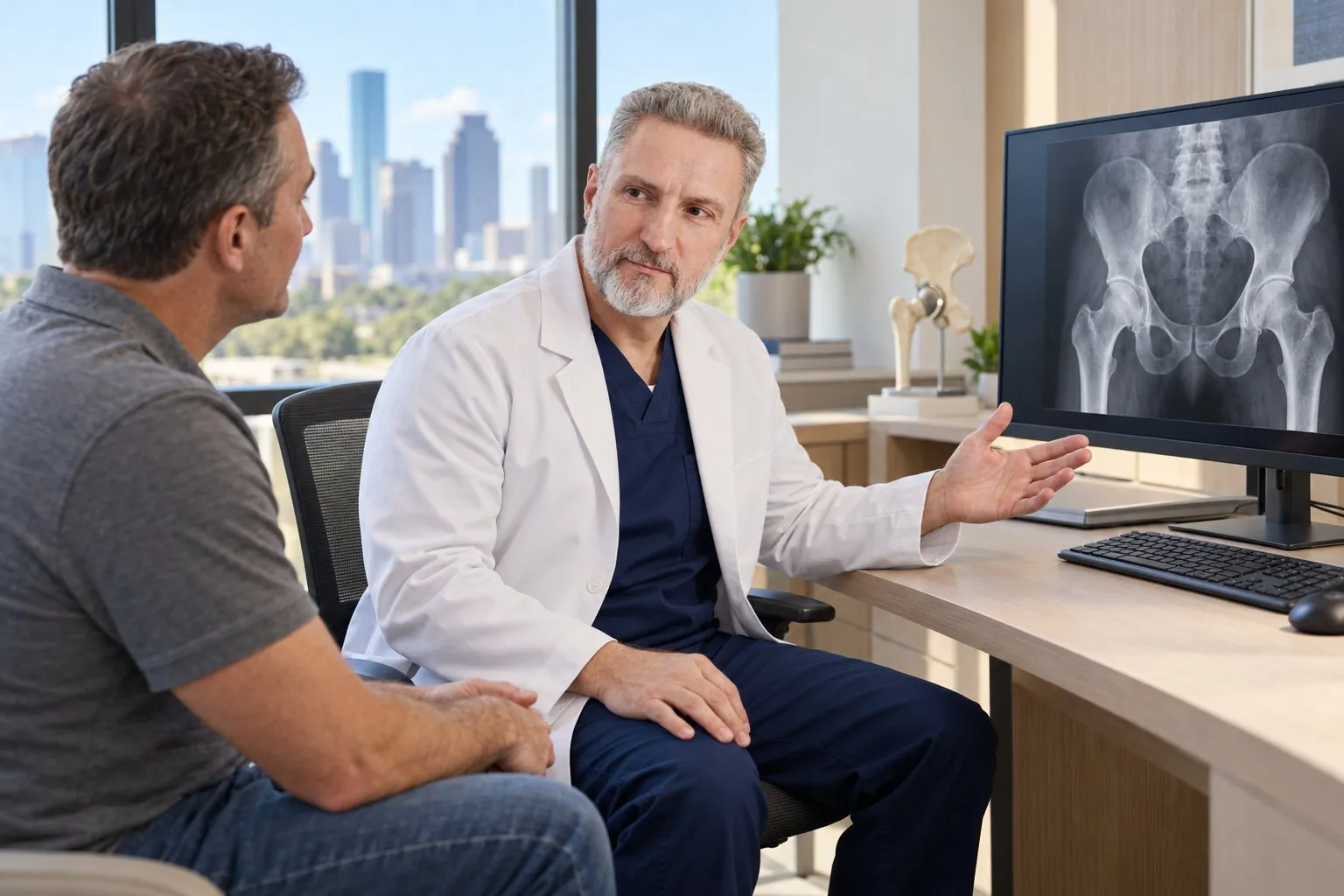
Standing X-rays, a false-profile view and often a CT or MRI let Dr. Stride measure coverage, socket tilt and cartilage health. He examines both hips, the back and your walking pattern, and talks through what dysplasia means for the long-term health of the hip.
Repositioning the socket
Through an incision at the front of the hip, a series of precise bone cuts free the socket from the pelvis while keeping the back column of the pelvis intact. The socket is rotated to cover the ball properly and fixed with screws. Live X-ray confirms the new position.
Hospital stay
PAO is a larger operation than a hip scope. Most patients stay in the hospital a few nights for pain control and to get up safely on crutches.
Protected healing
The bone cuts heal much like a fracture. Follow-up X-rays track healing before weight bearing increases.
Typical recovery timeline
Crutches with partial weight bearing, daily walking at home and gentle exercises. Fatigue is normal early on.
Once X-rays show healing, weight bearing increases and crutches are weaned. Many students and desk workers return to school or work around 6 to 8 weeks.
Strength, walking distance and endurance build steadily in physical therapy. Swimming and cycling come back.
Return to running, dance and sport for many patients, with full function often taking a year.
Timelines are typical ranges. Your plan depends on your hip, your health and what was done in surgery.
“PAO is a big operation, and I never pretend otherwise. For a young person with a shallow socket and healthy cartilage, though, it can fix the root cause instead of patching symptoms. I would much rather move your socket at 25 than replace your hip at 40.”
Dr. Stride, MD
Frequently asked questions
What are the signs of hip dysplasia in adults?
Adults with hip dysplasia often notice groin pain, a deep ache after activity, hip fatigue, a limp late in the day or clicking. Many were never diagnosed as babies, and the condition is often found on X-ray in the late teens to 30s.
How long is recovery from PAO surgery?
Most patients use crutches for 6 to 10 weeks and return to desk work or school in about 6 to 8 weeks. A full return to sport and maximum function typically takes 6 to 12 months.
Can hip arthroscopy fix hip dysplasia?
Arthroscopy can treat a labral tear but cannot deepen a shallow socket, and in true dysplasia an isolated scope may not address the underlying instability. Borderline cases are different, and Dr. Stride reviews the measurements with you before recommending either path.
Will you still need a hip replacement after PAO?
Some patients eventually do, especially if some cartilage wear was present before surgery. The goal of PAO is to preserve the natural hip and delay or avoid replacement, and it does not rule out a future replacement if one is needed.
Related treatments
Hip Arthroscopy
Hip arthroscopy is an outpatient surgery that uses a small camera and slim instruments, placed through two or three small incisions, to treat problems inside the hip joint.
Read more →PreservationHip Labral Repair
Hip labral repair is an arthroscopic surgery that reattaches a torn labrum, the ring of cartilage around the hip socket, using small anchors.
Read more →DiagnosisHip X-ray & MRI
Hip X-rays and MRI answer different questions.
Read more →ReplacementTotal Hip Replacement
Total hip replacement replaces the worn ball and socket of an arthritic hip with a metal, ceramic and medical-grade plastic implant.
Read more →Questions patients ask about this

Hip Pain in Women: Menopause, Bursitis and What Else It Could Be
Hip pain in women is most often caused by gluteal tendinopathy, the tendon problem usually called hip bursitis, which peaks between ages 40 and 60.

Yoga and Hip Pain: Poses That Help and Poses That Hurt
Yoga can help many people with hip pain by building strength, balance and comfortable mobility.
SourcesReferences used for this page3
Medically reviewed by Dr. Stride, MD against current guidance from these sources. Last reviewed October 2026. How we write and review content
- Periacetabular osteotomy to treat residual dysplasia in adolescents and young adults: indications, complications, results (opens in a new tab) Journal of Children's Orthopaedics (PMC)
- Developmental Dysplasia of the Hip (DDH) (opens in a new tab) AAOS OrthoInfo
- Hip Preservation for Young Adults (opens in a new tab) Cleveland Clinic