
Get a Clear Answer About Your Hip Pain
What happens at a hip exam with an orthopedic hip specialist?
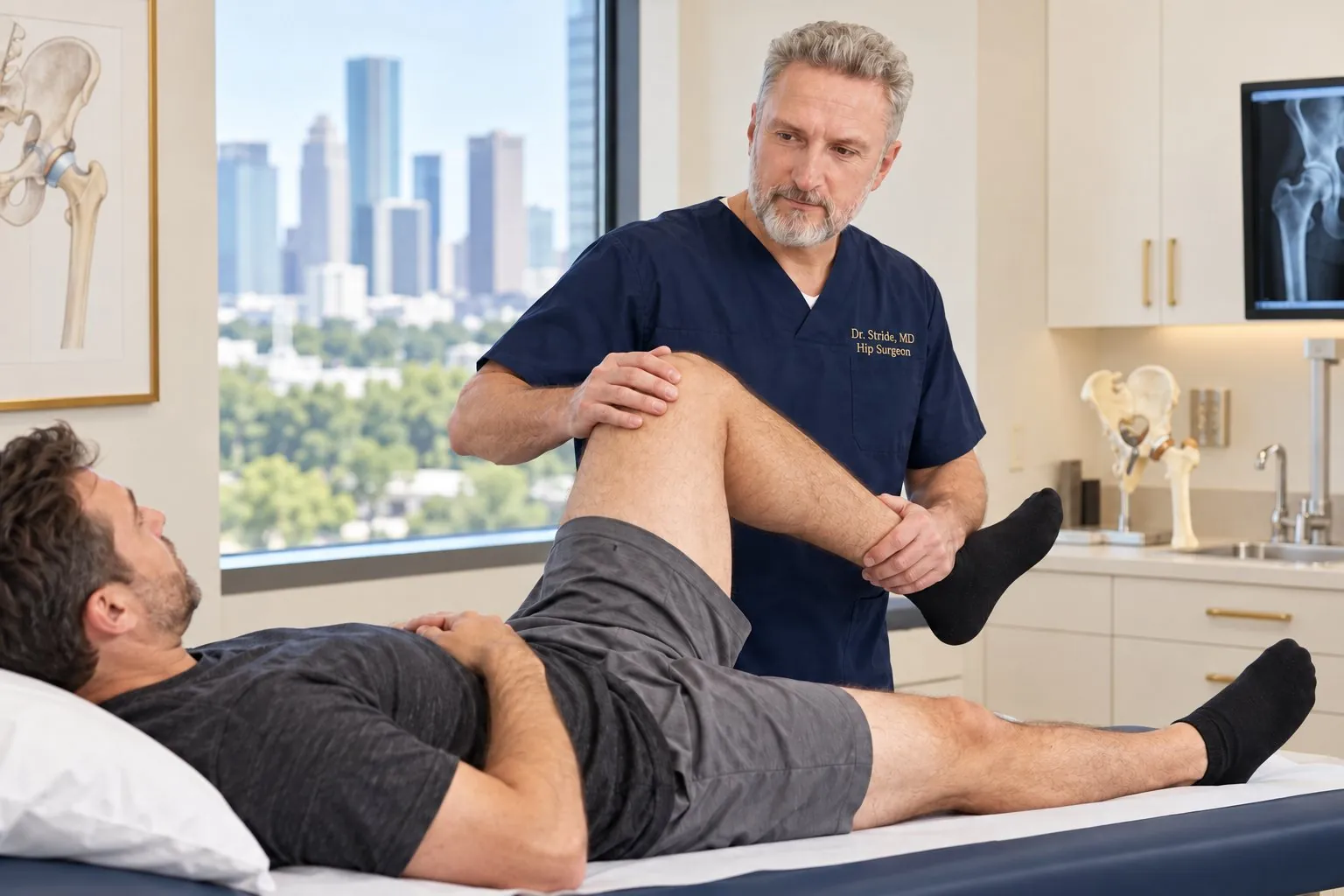
A hip exam with an orthopedic hip specialist is a hands-on check of range of motion, labral and impingement signs, tendon strength and walking pattern. Dr. Stride uses tests such as FADIR, FABER, log roll and single-leg stance, then screens the lower back and knee. The visit usually takes 30 to 45 minutes and sets the plan.
The same ache in the groin, the side of the hip or the buttock can come from the joint itself, the tendons around it or a nerve in the lower back. Dr. Stride's exam is built to tell those apart in one visit, before any MRI is ordered.
 Written and medically reviewed by Dr. Stride, MD, board-certified orthopedic surgeon
Last reviewed October 2026
At a glance
- Also called
- hip impingement test, FADIR test, FABER test, walking analysis for hip pain
- After your visit
- Follow-up visit
- Category
- Diagnosis & Evaluation
Is this right for you?
Usually a good fit if
- Groin pain that catches when you get out of the car or put on socks
- Side-of-hip pain that wakes you when you lie on that side
- Anyone who has an MRI report full of findings but no clear plan
- People told they need a new hip who want a second opinion
Another option may be better if
- A fall with sudden inability to stand or put weight on the leg, which needs an emergency room and X-rays first
- Hip pain with fever, chills or a hot, swollen joint, which needs same-day care to rule out infection
What happens, step by step
Your story and your goals
Dr. Stride asks what sets the pain off and what you want back, from 18 holes to carrying a grandchild upstairs. A cupped hand over the side of the hip (the C sign) usually points to the joint itself.
Range of motion and joint tests
Rotation is measured with the hip bent. The FADIR test (flexion, adduction, internal rotation) checks for impingement and labral irritation, FABER stresses the joint and sacroiliac area, and a gentle log roll looks for joint irritation.
Tendon and muscle checks
Pressing over the bony point on the side of the hip, a 30-second single-leg stance and resisted rotation tests help detect gluteal tendinopathy or a gluteus medius tear.
Gait analysis
You walk the hallway, step up and balance on each leg. A protective stride, a dropping pelvis (Trendelenburg sign) or a leg length difference each point somewhere different.
Spine and knee screen
A pinched nerve in the lower back often mimics hip pain, so every visit includes a straight leg raise and a lumbar check. The knee is examined too, since hip arthritis can show up as knee pain.
Could it start in your back?
Every hip exam includes the lower back: posture, a few nerve tests and a check of how the spine moves with the hip.
What happens after the visit
Dr. Stride explains the findings in plain language.
Most patients get standing X-rays in the office, reviewed right away.
If a labral tear, tendon tear or stress fracture is suspected, our team schedules an MRI and handles the insurance approval.
You start the first-step plan, often therapy, activity changes or medication.
Results are reviewed together. A diagnostic injection is added when the pain source is still unclear.
“Plenty of the hips sent to me for a second opinion turn out to have a back problem, a tendon problem or both. I would rather spend an extra ten minutes on the exam than send you down the wrong road. The MRI matters, but your hip tells me more when I move it.”
Dr. Stride, MD
Frequently asked questions
How can a doctor tell if hip pain is coming from the back?
Dr. Stride compares how the pain responds to hip tests and to back and nerve tests. Pain that shoots below the knee, comes with numbness, or worsens with a straight leg raise points toward the spine. When it is still unclear, a numbing injection into the hip joint can settle the question.
What should you wear to a hip appointment?
Wear shorts or loose athletic pants, or bring a pair to change into. Dr. Stride needs to see both hips move and watch you walk. Comfortable shoes you normally wear are helpful.
Can a hip specialist diagnose a labral tear without an MRI?
An experienced hip surgeon can often strongly suspect a labral tear from the history and exam alone. An MRI or MR arthrogram is usually still ordered before surgery to confirm the tear and check the cartilage. Many people over 40 have labral changes that cause no pain, so the exam decides what matters.
How soon can a new patient be seen?
New patients are usually seen within the week. The Saturday Hip Pain Clinic runs from 8 AM to noon for new hip pain and second opinions. Bring any X-rays or MRI discs you already have.
Related treatments
Hip X-ray & MRI
Hip X-rays and MRI answer different questions.
Read more →DiagnosisDiagnostic Hip Injection
A diagnostic hip injection places a numbing medicine directly into the hip joint under ultrasound or X-ray guidance.
Read more →Non-surgicalHip Physical Therapy
Physical therapy helps many types of hip pain, including arthritis, gluteal tendinopathy, hip impingement and many labral tears.
Read more →PreservationHip Labral Repair
Hip labral repair is an arthroscopic surgery that reattaches a torn labrum, the ring of cartilage around the hip socket, using small anchors.
Read more →Hip pain this can help with
Pain in the Back of the Hip and Buttock
Pain in the back of the hip and buttock most often comes from the lower back, such as a pinched nerve or sciatica, or from the sacroiliac joint.
Causes & treatment →Hip pain · symptomIs It Your Hip or Your Back?
Hip joint pain is usually felt in the groin or front of the thigh and flares with putting on socks or getting out of a car.
Causes & treatment →Hip pain · symptomHip Pain When Walking
Hip pain when walking is most often caused by hip osteoarthritis, which brings a groin ache and a limp, or by gluteal tendinopathy, which causes outer hip pain.
Causes & treatment →Questions patients ask about this

Hip Pain but the X-Ray Shows Nothing: What Next?
A normal hip X-ray means your bones look intact, but it does not rule out a problem.
How to Tell if Your Hip Pain Is Serious
Hip pain is serious if you cannot put weight on the leg, the leg looks shortened or turned out after a fall, the joint is hot and swollen with fever, or the pain is sudden and severe.
Is Hip Pain at Night a Sign of Cancer?
Hip pain at night is rarely a sign of cancer.
SourcesReferences used for this page3
Medically reviewed by Dr. Stride, MD against current guidance from these sources. Last reviewed October 2026. How we write and review content
- Hip pain (opens in a new tab) MedlinePlus
- Femoroacetabular Impingement (opens in a new tab) AAOS OrthoInfo
- Abnormal Gait: Gait Disorder Types, Causes & Treatments (opens in a new tab) Cleveland Clinic