In this guide
- The short answer
- Why does my hip hurt more at night?
- How should I sleep on my side with hip pain?
- Is back sleeping better for hip arthritis?
- Does my mattress matter?
- How should I sleep after hip arthroscopy or replacement?
- What else helps me sleep with hip pain?
- When is night hip pain a reason to see a specialist?
- Questions
- References
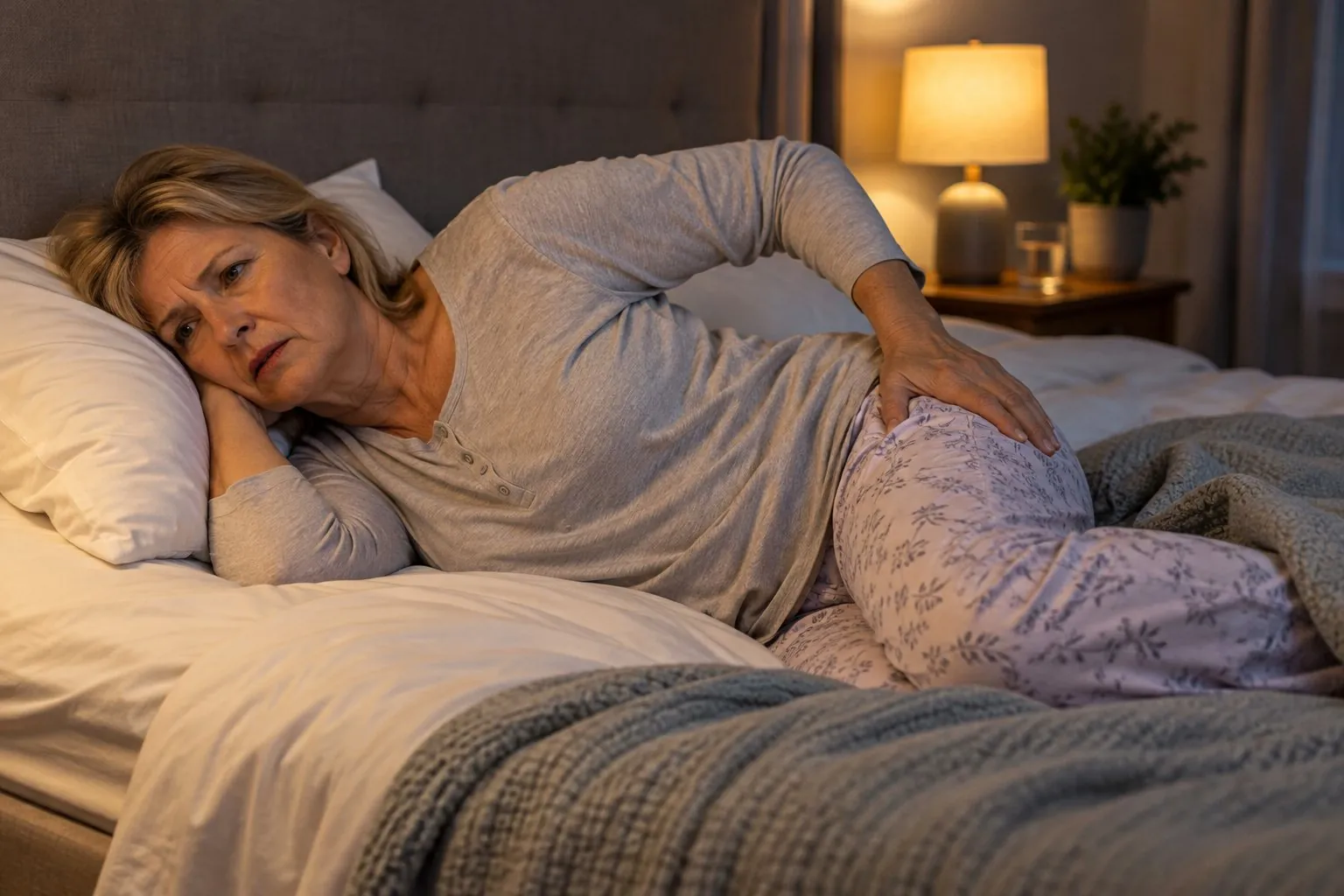
What is a good sleeping position for hip pain?
For most hip pain, sleeping on the side that does not hurt with a pillow between your knees is a good start. Back sleeping with a pillow under the knees often suits hip arthritis. Avoid lying directly on a painful outer hip. After surgery, follow your surgeon's position instructions exactly.
Why does my hip hurt more at night?
Lying still for hours puts steady pressure on some tissues and lets stiff joints settle. AAOS OrthoInfo notes that hip bursitis pain is typically worse at night, especially when lying on the affected hip.
Gluteal tendon pain on the outside of the hip behaves the same way. Cleveland Clinic lists lying on your side and getting out of bed in the morning among the triggers, and notes that the condition can make it hard to sleep well.
Arthritis and labral problems can also ache at night, often as a deep groin pain or stiffness after lying in one position. Pain that is severe and constant at night, regardless of position, is a different pattern and should be checked.
How should I sleep on my side with hip pain?
MedlinePlus suggests sleeping on the side of your body that does not have pain and putting a pillow between your legs. The pillow keeps the top leg level with the hip, so it does not drop forward and stretch the tendons on the outside of the painful hip.
Use a pillow thick enough to keep your knees about hip-width apart, or try a full-length body pillow that supports the leg from knee to ankle. Bending the knees slightly is usually more comfortable than lying with the legs straight.
If both hips hurt, try alternating sides through the night, using the pillow each time, or spend part of the night on your back. A soft cushion under the hip you are lying on can also take the edge off pressure on the bony point.
- Sleep on the side that does not hurt
- Place a firm pillow between the knees and ankles
- Keep the top leg level instead of letting it fall forward
- Hug a pillow so the upper body does not roll forward
- Avoid lying directly on the painful outer hip
Is back sleeping better for hip arthritis?
Many people with hip arthritis find back sleeping comfortable because it spreads body weight evenly and avoids pressure on either hip. A pillow under the knees takes strain off the hips and lower back.
If one hip is stiff, a small pillow under that knee alone can let it rest in a slightly bent, more comfortable position. If you tend to roll onto your painful side, a pillow along that side can act as a gentle barrier.
Stomach sleeping is the hardest position for most hips and lower backs, because it can arch the back and twist the hips. If you prefer it, a thin pillow under the hips may help.
Does my mattress matter?
A mattress that is too firm can press into the bony point of the hip when you lie on your side. One that is too soft can let the hips sink and twist out of line.
A medium-firm surface with some cushioning often works well for side sleepers with outer hip pain. A soft foam topper can add cushioning without replacing the whole mattress.
After a hip replacement, MedlinePlus recommends a firm mattress and a bed height that lets your feet touch the floor while your hips stay higher than your knees as you sit on the edge.
Before buying a new mattress, try the pillow changes for a couple of weeks. Many people find that positioning makes a bigger difference than the mattress itself.
How should I sleep after hip arthroscopy or replacement?
Follow your surgeon's instructions, because positions depend on the procedure and the surgical approach. OrthoInfo notes that after a hip replacement your surgeon may ask you to avoid certain sleeping positions or to sleep with a pillow between your legs for a period of time.
Many people sleep on their back for the first weeks, then move to the non-operated side with a pillow between the knees once comfortable and cleared. Sleeping on the operated side usually comes later, once tenderness at the incision fades.
After hip arthroscopy, some surgeons use a brace or specific position limits early on to protect a labral repair. Ask before changing positions, and plan your pillows before the first night home.
What else helps me sleep with hip pain?
A short walk or gentle stretching in the evening can ease stiffness. Some people find that a warm shower before bed loosens the hip.
Over-the-counter pain relievers taken before bed can help some people, if they are safe for you. Check with your doctor or pharmacist, especially if you take other medicines or have kidney, stomach or heart problems.
Avoid long periods on low couches in the evening, which keep the hip deeply bent. Getting up during the evening to move can make the first hours in bed more comfortable.
When is night hip pain a reason to see a specialist?
If pain wakes you most nights despite these changes, an exam can find the cause and open more options, from physical therapy to a targeted injection for outer hip pain.
Outer hip pain that wakes you at night is often treatable. Physical therapy to strengthen the gluteal tendons is the usual first step, and a corticosteroid injection may be considered for short-term relief when pain is limiting sleep and exercise.
Seek prompt care for night pain with fever, unexplained weight loss, pain that is severe and constant regardless of position, or night pain after a fall. Our Saturday Hip Pain Clinic sees most new patients within the week, so bring any X-rays or MRI you have.
Questions patients ask
Why does my hip hurt when I sleep on my side?
The most common reason is irritation of the gluteal tendons or bursa on the outside of the hip, which dislike direct pressure. Lying on the other side can also hurt if the top leg drops forward and stretches those tendons. A pillow between the knees often helps.
Is it better to sleep on the painful hip or the other side?
Most people are more comfortable sleeping on the side that does not hurt, with a pillow between the knees. Lying directly on a painful outer hip usually increases pressure on the sore tendons. Back sleeping is another good option.
Can I sleep on my side after hip replacement?
Many people can sleep on their side after hip replacement once their surgeon allows it, usually with a pillow between the knees. Instructions vary by surgical approach and surgeon. Ask which positions are safe for you.
SourcesReferences5
Medically reviewed by Dr. Stride, MD. How we write and review content. This guide is educational and does not replace an exam.
- Hip pain (opens in a new tab) MedlinePlus
- Hip Bursitis (opens in a new tab) AAOS OrthoInfo
- Gluteal Tendinopathy: Symptoms, Causes & Treatment (opens in a new tab) Cleveland Clinic
- Activities After Total Hip Replacement (opens in a new tab) AAOS OrthoInfo
- Hip replacement - discharge (opens in a new tab) MedlinePlus