In this guide
- The short answer
- What is hip impingement?
- What does hip impingement feel like?
- Why does it show up in active adults?
- How is impingement linked to labral tears and arthritis?
- How is hip impingement diagnosed?
- Which exercises should I avoid with hip impingement?
- When does hip arthroscopy make sense for impingement?
- Questions
- References
hip impingement symptoms
Hip impingement usually causes a deep ache or sharp pain in the groin, sometimes toward the outside of the hip. It flares with squatting, pivoting, deep bending and long periods of sitting. Many people also feel stiffness or clicking. Over time, impingement can tear the labrum and raise the risk of arthritis in that hip.
What is hip impingement?
The hip is a ball-and-socket joint. In impingement, extra bone on the ball, the socket or both gives the joint an irregular shape, so the bones pinch against each other at the end of certain movements. The American Academy of Orthopaedic Surgeons explains that this shape develops during the childhood growing years, and exercise does not cause it.
There are three types:
- Cam impingement: the ball is not perfectly round, and a bump on its edge grinds the cartilage inside the socket. Cleveland Clinic notes this type is more common in men.
- Pincer impingement: extra bone extends over the rim of the socket and crushes the labrum, the cartilage rim of the socket.
- Combined impingement: both cam and pincer shapes are present, which is common. Women are more likely to have pincer or combined types.
What does hip impingement feel like?
Many people with an impingement shape never have symptoms. When symptoms do develop, they usually mean the labrum or cartilage is being irritated or damaged. Common signs include:
Impingement pain usually builds over weeks or months rather than starting with one injury. If groin pain began suddenly after a fall, or you cannot bear weight, seek same-day care, because a fracture or other injury needs to be ruled out first. Pain with fever also needs prompt attention.
- Pain deep in the groin, sometimes felt toward the outside of the hip, the buttock or the thigh.
- Sharp, stabbing pain with turning, twisting, squatting, lunging or jumping.
- A dull ache that lingers, sometimes described as a deep bruise.
- Pain after sitting for a long time, in low chairs or in the car.
- Stiffness, reduced hip rotation, and sometimes clicking or catching.
“Most active adults with impingement do not need to quit their sport. They need to understand which motions pinch and what to do about it.”
Why does it show up in active adults?
The bone shape is usually present for years before it hurts. Athletic people work their hips harder and through bigger ranges of motion, so they tend to notice symptoms sooner. Sports and activities that load deep hip flexion and rotation, such as pickleball, tennis, golf, soccer, hockey, dance, yoga and heavy squatting, are common triggers.
That is why impingement is often found in young and middle-aged adults who have been active their whole lives. It is also why stopping activity is rarely the whole answer. Learning which movements pinch, and changing them, is usually more useful.
How is impingement linked to labral tears and arthritis?
Each pinch puts pressure on the labrum and the cartilage at the edge of the socket. Over time, that repeated contact can tear the labrum and wear down cartilage. Cleveland Clinic lists impingement as the most common cause of hip labral tears.
OrthoInfo notes that once symptoms appear, damage is usually present and is likely to worsen, and that untreated painful impingement can lead to more joint damage over time. Impingement also raises the risk of osteoarthritis in that hip. This is the main reason ongoing groin pain in an active adult deserves a proper evaluation instead of years of guesswork.
How is hip impingement diagnosed?
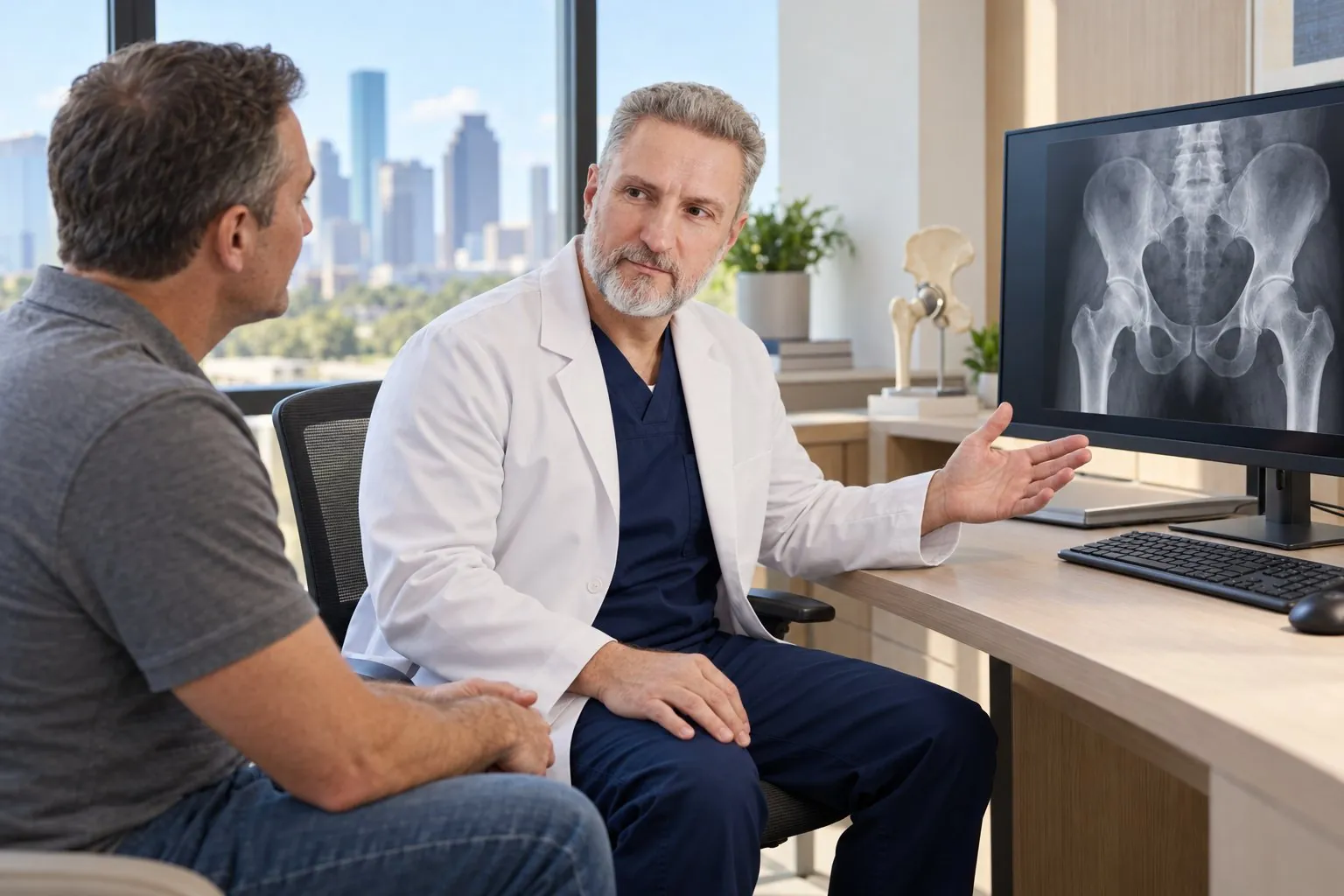
Diagnosis starts with your history and an exam. In the impingement test, the doctor bends your knee toward your chest and rotates it inward. If that recreates your groin pain, the test is positive.
Standing X-rays show the shape of the ball and socket and any arthritis. A CT scan can map the bone shape in detail when surgery is being planned, and an MRI shows the labrum and cartilage. A numbing injection into the joint can confirm that the pain is coming from inside the hip.
An impingement shape on an X-ray does not mean you need treatment by itself. Plenty of people have that shape without pain. The diagnosis of symptomatic impingement depends on the combination of your symptoms, the exam and the imaging all pointing the same way.
Which exercises should I avoid with hip impingement?
Staying active is usually fine. Some movements are worth modifying while the hip is sore:
Good alternatives often include cycling with the seat raised a little, swimming, walking, and strength work within a comfortable range. A physical therapist can show you how far you can bend before the pinch starts and help you train hip and core control so the joint is better supported during sport.
- Deep squats past the point of a pinch, and deep lunges.
- Leg press and machines that drive the knee toward the chest.
- Yoga poses that pull the knee deep toward the chest or across the body, until your therapist clears them.
- Sitting low or cross-legged for long periods.
- Hard cutting and pivoting during flares.
When does hip arthroscopy make sense for impingement?
Treatment usually starts with activity changes, anti-inflammatory medicine if it is safe for you, and physical therapy to strengthen the hip and core and improve control. An injection may be used to calm a flare or confirm the diagnosis.
Surgery is considered when symptoms persist despite good non-surgical care and imaging shows impingement-related damage. In hip arthroscopy, the surgeon repairs the labrum through small incisions and trims the extra bone so the joint moves without pinching. In a multicenter trial published in The BMJ, people with symptomatic impingement who had arthroscopy reported better hip function at eight months than those treated with physiotherapy and activity changes.
Recovery after arthroscopy takes patience. OrthoInfo notes some people use crutches only until a limp settles, while more extensive repairs can need crutches for 1 to 2 months, followed by structured physical therapy. Cleveland Clinic notes recovery after hip arthroscopy usually takes around four to six months, and many people return to full activity.
Surgery is less helpful when significant arthritis is already present. If pivoting, squatting or sitting has been causing deep groin pain for more than a few weeks, an exam at the Saturday Hip Pain Clinic is a good next step, and you can bring any X-rays or MRI you already have.
Questions patients ask
Can hip impingement go away on its own?
The bone shape does not change on its own, though symptoms often calm down with activity changes and therapy. Cleveland Clinic notes that correcting the shape requires surgery. Many people manage well without it.
Is hip impingement the same as a labral tear?
No. Impingement is the bone shape problem, and a labral tear is damage to the cartilage rim of the socket. Impingement is the most common cause of labral tears, so the two often occur together.
Can I keep playing pickleball with hip impingement?
Often yes, with adjustments. Strengthening, a good warm-up and limiting deep lunges and hard pivots can help many players keep going. If pain keeps building or you feel catching, get an exam.
SourcesReferences5
Medically reviewed by Dr. Stride, MD. How we write and review content. This guide is educational and does not replace an exam.
- Femoroacetabular Impingement (opens in a new tab) AAOS OrthoInfo
- Hip Impingement (Femoroacetabular Impingement or FAI): Types (opens in a new tab) Cleveland Clinic
- Hip Labral Tear: Symptoms & Treatment (opens in a new tab) Cleveland Clinic
- Arthroscopic hip surgery compared with physiotherapy and activity modification for the treatment of symptomatic femoroacetabular impingement: multicentre randomised controlled trial (opens in a new tab) The BMJ
- Hip Arthroscopy (opens in a new tab) AAOS OrthoInfo