In this guide
How to tell if you tore your hip labrum?
A torn hip labrum usually causes deep groin or front-of-hip pain that worsens with sitting, pivoting and deep bending, often with clicking, catching or locking. Many people cup the side of the hip in a C shape to show where it hurts. An exam and an MR arthrogram confirm the diagnosis, and many tears occur alongside hip impingement.
What is the hip labrum?
Your hip is a ball-and-socket joint. AAOS OrthoInfo describes the labrum as a ring of strong fibrocartilage around the rim of the socket that works like a gasket, creating a seal and helping keep the joint stable. Cleveland Clinic explains that it lines and protects the socket and helps the bones move smoothly.
A tear means part of that rim has split or pulled away from the bone. Some tears cause no trouble at all. Cleveland Clinic notes that some people with small tears have no symptoms and only learn about them on imaging done for another reason. Others cause pain that changes how they sit, walk and play.
What does a hip labral tear feel like?
Cleveland Clinic describes labral tear pain as a constant dull ache that can turn sharp in certain positions, and that feels deep inside the hip, closer to bone pain than to a surface muscle ache. Pain may also spread to the groin, lower back or leg. These are the patterns our team hears most often:
- Deep pain in the front of the hip or groin
- Pain with sitting for long periods, getting in and out of a car or putting on shoes
- Sharp pain when pivoting, twisting or turning in toward the painful side
- Clicking, popping, catching or a brief locking sensation
- Stiffness or a feeling that the hip is unstable or gives way
“A labral tear is often one piece of a bigger picture, so we look at the shape of the hip as well as the tear.”
What is the C sign?
When asked where it hurts, many people with a problem inside the hip joint cup their hand around the side of the hip in the shape of a C. A review in Revista Brasileira de Ortopedia describes this "C sign" as characteristic of intra-articular hip problems: the thumb sits behind the bony point on the outer hip and the fingers wrap toward the groin.
The same review notes that front-of-groin pain that worsens with prolonged standing, sitting or walking, and pain with inward rotation or pivoting sports, points toward a problem inside the joint such as impingement or a labral tear. The C sign is only a clue. Still, it helps separate deep joint pain from tendon pain on the surface of the outer hip.
Why do labral tears so often come with hip impingement?
Cleveland Clinic names femoroacetabular impingement (FAI) as the most common cause of hip labral tears. In FAI, AAOS OrthoInfo explains, extra bone along the ball, the socket or both gives the joint an irregular shape. The bones rub during movement, and over time this friction can tear the labrum and wear the cartilage.
That is why our team looks at bone shape as well as the labrum. A tear caused by impingement may keep coming back if the bony shape is not addressed. Other causes include sports injuries, falls and car accidents, and wear from osteoarthritis. Cleveland Clinic lists hockey, dance, football, soccer, golf and gymnastics as sports with higher risk.
How is a hip labral tear diagnosed?
Diagnosis starts with your history and a careful exam. AAOS OrthoInfo describes the impingement test, in which the doctor brings your knee toward your chest and rotates it inward; if that recreates your pain, the test is positive. Dr. Stride also checks your back, tendons and strength, since several problems can cause groin pain.
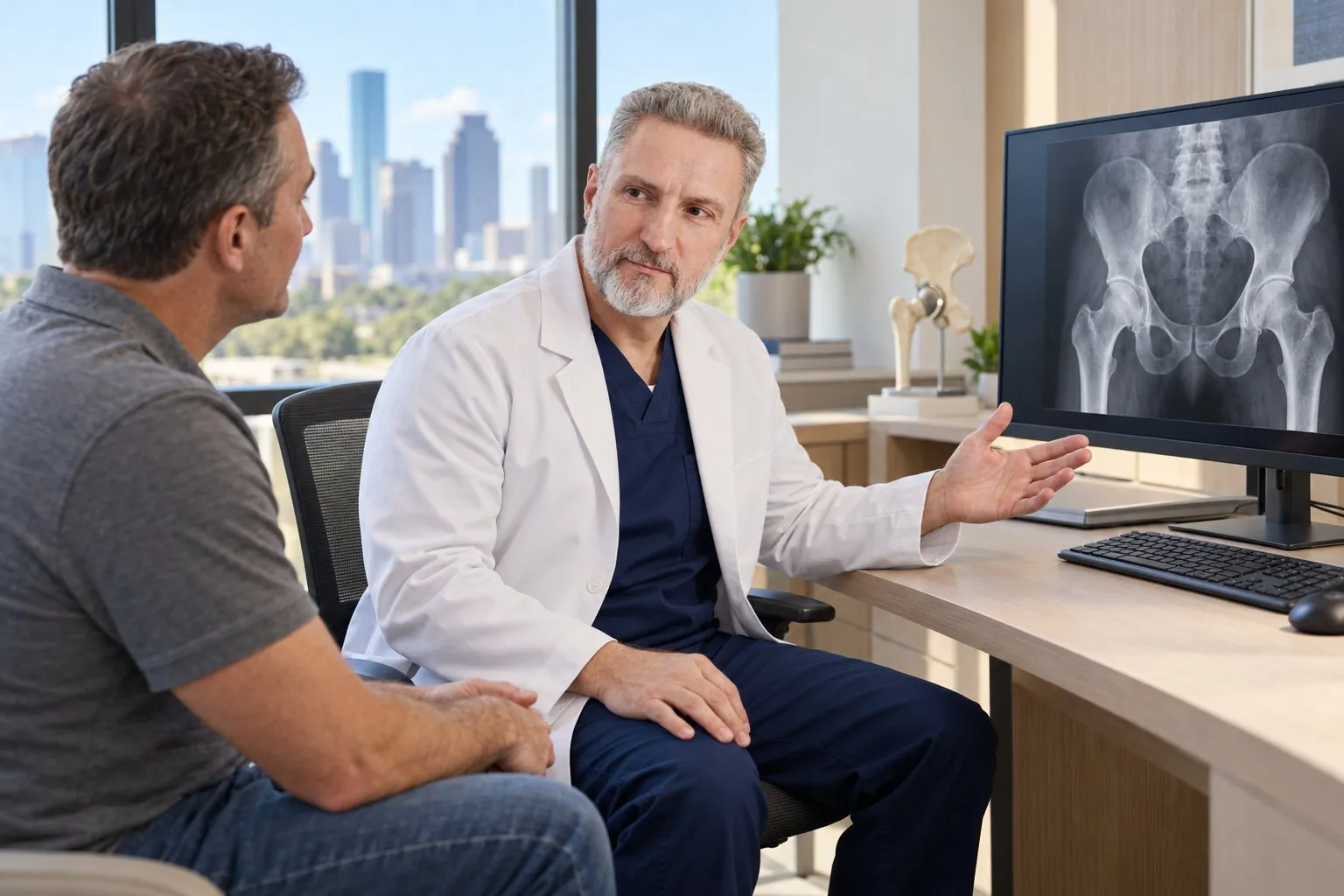
X-rays come first to look at bone shape and arthritis. An MRI shows soft tissue, and AAOS OrthoInfo notes that injecting dye into the joint during the MRI, called an MR arthrogram, can make labral and cartilage damage show up more clearly. The Revista Brasileira de Ortopedia review reports that MR arthrography was more accurate than standard MRI for finding these injuries in hips with FAI.
Sometimes a numbing injection into the joint is used as a test. AAOS OrthoInfo explains that if the numbing medicine brings temporary relief, it confirms the pain is coming from inside the hip.
Does a torn labrum always need surgery?
No. Many people do well with physical therapy, activity changes and short-term pain relief. Cleveland Clinic notes that some people manage symptoms with nonsurgical treatment, while surgery is the only way to actually repair a tear. Strengthening the hip and core muscles can take pressure off the joint and calm symptoms.
When pain persists despite good non-surgical care, hip arthroscopy may be an option. AAOS OrthoInfo describes it as a procedure that uses a small camera and thin instruments through small incisions to repair the labrum and, when needed, reshape the bone causing impingement.
The decision depends on more than the MRI. Your age, the amount of arthritis on X-ray, how long you have had symptoms and what you want to get back to all shape the plan. Repairing the labrum does not restore worn cartilage, which is one reason Dr. Stride reviews standing X-rays closely before recommending any surgery. Our team walks you through the pros and cons of each path so the choice is yours.
When should you get your hip checked?
Cleveland Clinic advises seeing a provider if hip pain or stiffness does not improve within a few weeks. True locking, where the hip catches and will not move for a moment, or a hip that gives way under you deserves an exam soon, since these mechanical symptoms suggest something inside the joint. Pain that is slowly spreading to more activities, or that now bothers you at rest, is also worth checking.
If you are an active adult with deep groin pain that keeps coming back with sitting, pivoting or sport, the Saturday Hip Pain Clinic in Memorial City is a good place to start. Bring any X-rays or MRI you already have, and our team will help you find out whether the labrum is the problem and what your options are.
Questions patients ask
Can a hip labral tear show up on a regular MRI?
Sometimes, but not always. AAOS OrthoInfo notes that dye injected into the joint during the MRI can make labral damage show more clearly. That test is called an MR arthrogram.
Can you walk with a torn hip labrum?
Yes, most people can walk, though it may hurt with longer walks, pivoting or uneven ground. Some people limp or feel the hip is unstable. Walking ability alone does not rule out a tear.
What makes a hip labral tear worse?
Deep bending, twisting, pivoting sports and long periods of sitting tend to aggravate a labral tear. Activities that bring the knee toward the chest and turn it inward are common triggers. Physical therapy can teach you safer ways to move.
SourcesReferences5
Medically reviewed by Dr. Stride, MD. How we write and review content. This guide is educational and does not replace an exam.
- Hip Labral Tear: Symptoms & Treatment (opens in a new tab) Cleveland Clinic
- Femoroacetabular Impingement (opens in a new tab) AAOS OrthoInfo
- Femoroacetabular Impingement and Acetabular Labral Tears - Part 2: Clinical Diagnosis, Physical Examination and Imaging (opens in a new tab) Revista Brasileira de Ortopedia (PMC)
- Hip Arthroscopy (opens in a new tab) AAOS OrthoInfo
- X-rays, CT Scans, and MRI Scans (opens in a new tab) AAOS OrthoInfo