In this guide
- The short answer
- Is yoga safe for people with hip pain?
- Which poses can aggravate hip problems?
- Why are impingement, labral tears and dysplasia different?
- Which poses tend to help hip arthritis and tendon pain?
- How can I modify poses to protect my hip?
- What signs mean I should stop and get checked?
- How can a hip specialist help yoga lovers?
- Questions
- References
Is yoga good or bad for hip pain?
Yoga can help many people with hip pain by building strength, balance and comfortable mobility. Deep hip openers such as pigeon, lotus and deep lunges can aggravate impingement, labral tears and hip dysplasia. Gentle strengthening poses tend to suit arthritis and tendon pain. Modify any pose that pinches or lingers after class.
Is yoga safe for people with hip pain?
For most people, yes, with sensible choices. The National Center for Complementary and Integrative Health (NCCIH) describes yoga as generally safe for healthy people when done properly under a qualified instructor, with a lower injury risk than higher-impact activities.
NCCIH notes that the most common yoga injuries are sprains and strains, and that older adults may need to be particularly cautious. Research also suggests yoga may improve balance and help with some types of joint pain.
The hip-specific risk comes from end-range positions. A pose that feels like a deep stretch in a healthy hip can pinch or strain a hip with a structural problem.
Class style matters as well. Slow, alignment-focused classes give you time to adjust each pose, while fast flows and heated classes can encourage pushing deeper than the hip is ready for. Beginners and people returning after an injury often do well starting with gentle or chair-based classes.
Which poses can aggravate hip problems?
These poses combine deep hip bending, rotation or wide splits. Some people do them comfortably, and they are also common triggers for hip pain.
- Pigeon pose: deep flexion and rotation of the front hip
- Lotus and half lotus: forceful outward rotation
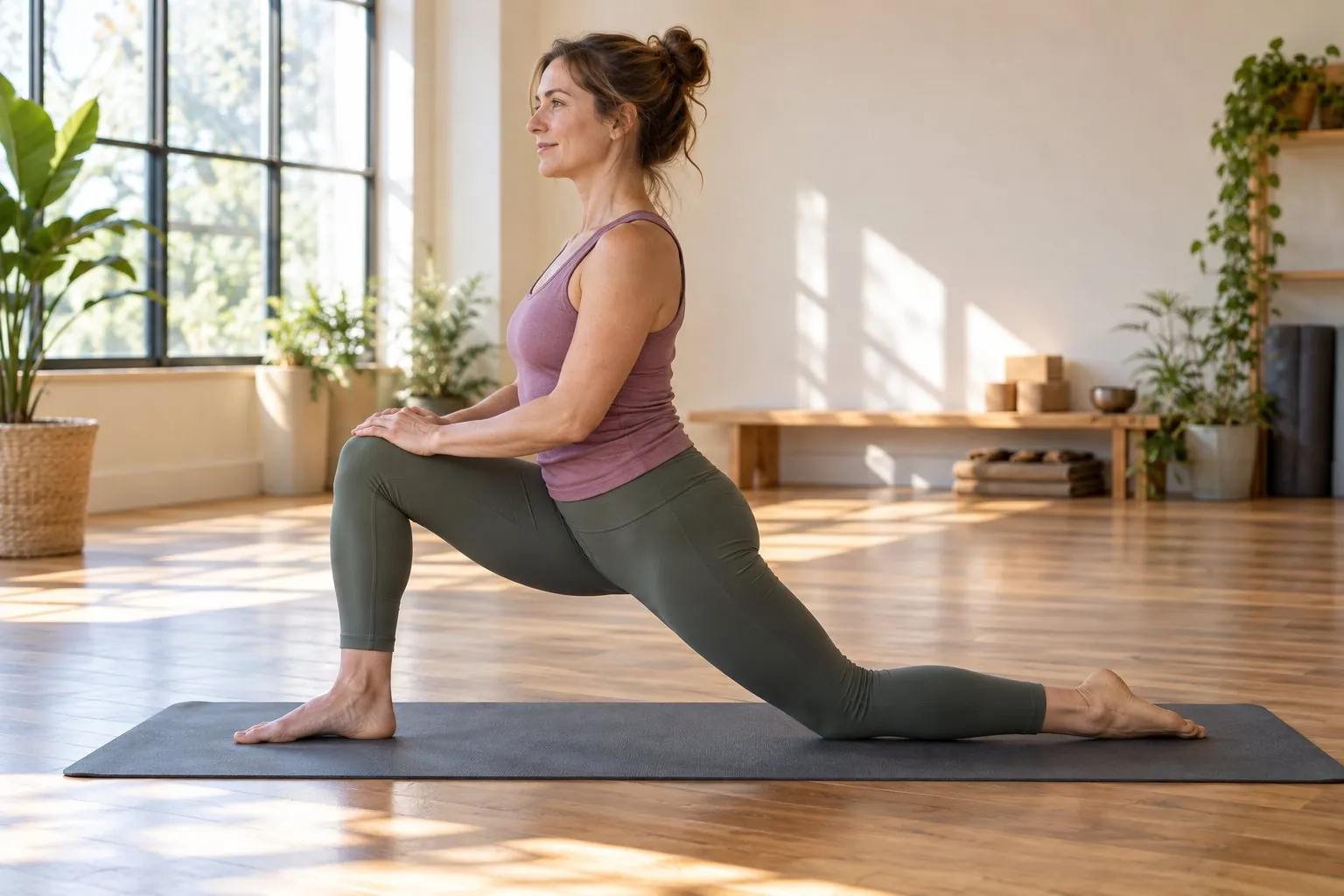
- Deep lunges and lizard pose: end-range bending at the front hip
- Happy baby and deep squats (malasana): full flexion that can pinch
- Wide-legged splits and frog pose: stress on the labrum and groin
- Long holds in cross-legged or figure-four positions: compress outer hip tendons
“Flexibility is a gift on the mat, and for some hips the safest practice is building strength to control it.”
Why are impingement, labral tears and dysplasia different?
In femoroacetabular impingement (FAI), extra bone makes the ball and socket meet early. AAOS OrthoInfo notes that turning, twisting and squatting may cause sharp, stabbing groin pain. Pushing past that point in a pose can repeatedly pinch the labrum.
Hip dysplasia is the opposite problem: the socket is too shallow to fully cover the ball. OrthoInfo explains that the altered forces in a dysplastic hip gradually damage the cartilage and labrum, and that the pain is usually in the groin and worse with activity. Some people with dysplasia are very flexible, so deep stretches can feel easy while still overloading the joint.
A torn labrum adds another layer. Cleveland Clinic lists pain with bending and movement, stiffness, and clicking or popping as common symptoms. Poses that recreate that click are worth avoiding until the hip is evaluated.
Which poses tend to help hip arthritis and tendon pain?
For arthritis, gentle movement through a comfortable range and strength work around the hip usually help more than forceful stretching. For outer hip tendon pain, strengthening the glutes while avoiding compression is the general approach.
Cleveland Clinic advises people with gluteal tendinopathy to avoid crossing the legs and low chairs, which also argues against long holds in crossed-leg poses. Standing poses that build glute strength, done with good alignment, are usually better tolerated.
- Bridge pose for glute and hamstring strength
- Mountain pose and tree pose, with a wall nearby for balance
- Warrior II with a shorter stance
- Chair pose to a comfortable depth
- Supported reclined poses with blocks under the knees
- Gentle cat-cow to move the spine and pelvis
How can I modify poses to protect my hip?
Small changes make a big difference. Use blocks to raise the floor, shorten your stance, reduce depth and keep the pelvis level rather than letting it drop or twist.
Swap pigeon for a reclined figure-four stretch with the foot resting lower on the opposite thigh, or skip it if it pinches. In lunges, keep the back knee down and shorten the stride. In seated poses, sit on a folded blanket so the hips are higher than the knees.
Let your instructor know about your hip. A good teacher will offer options and will not push you deeper into a pose that hurts.
Pay attention to transitions as well as the poses themselves. Stepping a foot forward from downward dog into a lunge is a common moment for a sharp pinch, so use your hand to help place the foot or come to your knees first.
What signs mean I should stop and get checked?
Mild muscle stretch that fades quickly is normal. Joint pain that lingers is a different message.
Many people with these symptoms can keep practicing yoga with a modified routine once the cause is clear.
- A sharp pinch in the groin during a pose
- Clicking, catching or locking in the hip
- Pain that lingers for hours or into the next day after class
- The hip feeling unstable or giving way
- Outer hip pain that is worse lying on that side at night
How can a hip specialist help yoga lovers?
An exam and X-rays can show whether your hip shape leans toward impingement or dysplasia, which changes how you should practice. When a labral tear is suspected, an MRI or MR arthrogram may follow.
Most people improve with a modified practice and physical therapy. For those with structural problems that do not settle, procedures such as hip arthroscopy or, for dysplasia, a periacetabular osteotomy aim to preserve the natural hip. Our team will help you find a plan that keeps you on the mat.
Our Saturday Hip Pain Clinic is a good fit for active adults with new hip pain or questions about a previous diagnosis. Bring any imaging you have and a list of the poses that bother you, so the plan can address your actual practice.
Questions patients ask
Is it normal for my hips to be sore after yoga?
Mild muscle soreness that fades within a day can be normal after a new or deeper class. Sharp groin pain, clicking or soreness that lasts into the next day suggests the joint is being irritated. Modify the poses involved and get checked if it continues.
Is yoga good for hip arthritis?
Gentle yoga that focuses on comfortable movement, balance and strength can be helpful for many people with hip arthritis. Avoid forcing deep stretches into stiff, painful ranges. A physical therapist or experienced instructor can help adapt poses.
Why does my hip pop when I stretch?
Popping without pain often comes from a tendon sliding over bone and is usually harmless. Popping with pain, catching or locking can point to a labral tear. That combination deserves an exam.
SourcesReferences5
Medically reviewed by Dr. Stride, MD. How we write and review content. This guide is educational and does not replace an exam.
- Yoga: Effectiveness and Safety (opens in a new tab) NCCIH (NIH)
- Femoroacetabular Impingement (opens in a new tab) AAOS OrthoInfo
- Adolescent Hip Dysplasia (opens in a new tab) AAOS OrthoInfo
- Hip Labral Tear: Symptoms & Treatment (opens in a new tab) Cleveland Clinic
- Gluteal Tendinopathy: Symptoms, Causes & Treatment (opens in a new tab) Cleveland Clinic